The short answer
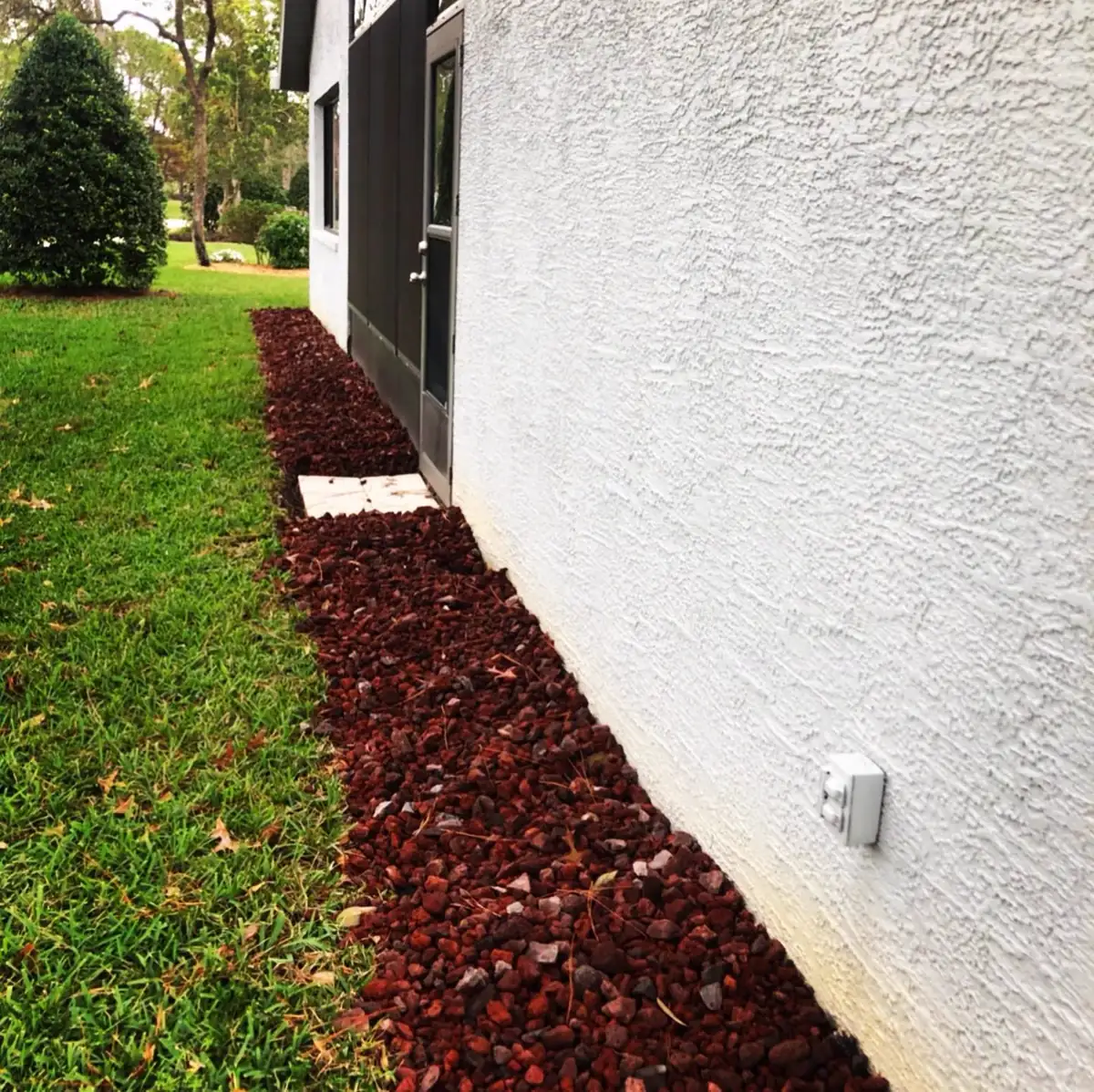
Use rock along the foundation, around trees, and next to the driveway, where it will not wash out or scatter. Use mulch in beds full of plants, where you want the soil to stay cool and get better over time. Many Spring Hill yards use rock in front and mulch in back.
Mulch
Mulch looks natural, feeds the soil as it breaks down, and keeps roots cool. The catch: in Florida it breaks down fast. Expect to top it off every year, and heavy rain can wash it out of sloped beds. Brown and black mulch hold their color longer than red.
Rock
White marble, lava rock, and river rock cost more up front but last for years. Rock does not wash out, does not fade much, and blocks weeds well when weed fabric goes under it. It does hold heat, so keep it a few inches back from tender plants.
Landscape rock types we install
| Rock | Looks like | Best for | Watch for |
|---|---|---|---|
| White marble | Bright white chips | Front beds and borders that should stand out | Shows dirt and leaves; can raise soil pH, so keep it away from azaleas and gardenias |
| River rock | Smooth, rounded, tan and gray | Downspouts, drainage spots, tree rings | Rolls underfoot; heavy to move later |
| Lava rock | Light, porous, deep red | Color accents and borders | Rough edges; the red can fade in full sun over the years |
| Pea gravel | Small, round pebbles | Paths, side yards, between pavers | Shifts underfoot, so it needs a solid edge |
For mulch, we install brown, black, and red.
Where each one wins
Rock is the better choice along foundations, around tree rings, and in beds near the driveway where mulch would scatter. Mulch is the better choice in plant-heavy beds where you want the soil to improve.
How much mulch or rock do you need?
Measure the bed in square feet: length times width. Mulch goes down 2 to 3 inches deep, and rock about 2 inches. Multiply the square feet by the depth in inches, then divide by 324 to get cubic yards. A 10 by 20 foot bed is 200 square feet, so 3 inches of mulch is about 1.9 cubic yards and 2 inches of rock is about 1.2 cubic yards. Rock yards often sell by the ton: dense stone like river rock and pea gravel weighs roughly 1.3 to 1.4 tons per cubic yard, while lava rock is much lighter, so ask the yard to convert.
What drives the cost
Rock costs more up front: the stone, the weed fabric under it, and the labor to haul and spread it. Mulch costs less to put down but needs a fresh layer every year, so the gap narrows over time. Bed size, the stone you pick, and how far it has to be carried set the price, so every job gets its own written quote.
What about rubber mulch?
Rubber mulch does not break down or feed the soil, it gets hot in full sun, and it is hard to get out of a bed later. We install wood mulch and rock instead.
The mistake to avoid
Never lay rock straight on soil without fabric. Within a season, dirt works up between the stones and weeds take over. Fabric is a small cost that saves the whole install.
Not sure?
Send us a photo of the bed. Supreme Landscape does mulch and rock installation across Hernando County, with weed fabric under every rock bed, and will tell you straight which one fits. Overgrown beds get cleared first with weeding and bed cleanup. Call or text 727-809-8150.
Source: UF/IFAS Gardening Solutions: Choosing and Installing Mulches